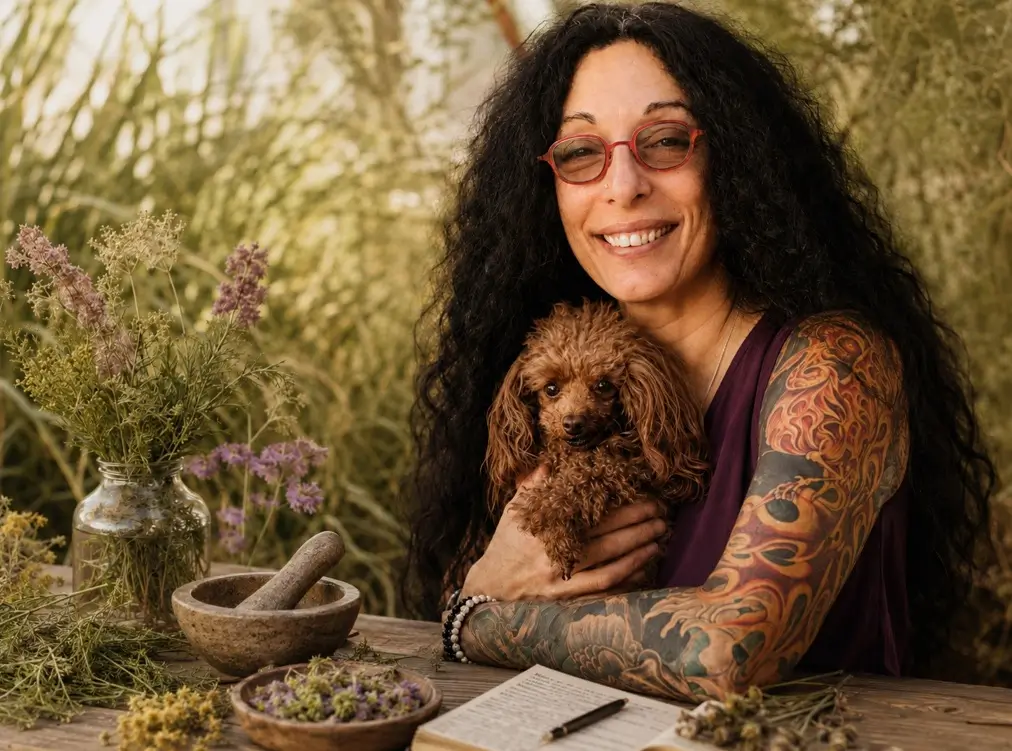
Long before Virginia Joy Musacchio knew anything about essential oils, she knew she wanted to teach.
She was seven years old when she first understood that about herself. Growing up in New York, teaching felt less like a career choice than something already woven into her nature. There was a brief detour into nursing at Adelphi University, which ended rather spectacularly after Musacchio discovered that hospital smells, blood, and bedpans were not remotely compatible with her constitution. She changed her major to education, returned to the school district she herself had attended, and spent the next ten years teaching fifth grade. She eventually ran the district’s science program and worked in conjunction with Columbia University training teachers in the teaching of writing.
Nearly four decades later, Musacchio is still teaching. The classroom, however, has changed considerably.
Today she is the founder of Stillpoint Aromatics and The School at Stillpoint, a clinically trained and registered aromatherapist, massage therapist, bereavement counselor, energy-medicine practitioner, trained distiller, published aromatherapy writer, and national conference speaker. Her work has moved through education, bodywork, aromatic medicine, grief, energetic practice, and immersive programs such as Aromatic Mystery School.
The thread connecting all of it is not a particular modality. It is inquiry.
Musacchio has spent a lifetime wanting to know what lies underneath the thing we think we already understand.
Aromatherapy, it turns out, has given her plenty to question.
What Does It Mean to Know a Plant?
Professional aromatherapy requires real study. Musacchio has never argued otherwise. Her students learn chemistry, botany, physiology, safety, formulation, extraction, therapeutic action, consultation, and the responsible use of aromatic materials. The School at Stillpoint continues to offer her 300-hour Aromatherapy Certification Program, a rigorous professional course designed to prepare practitioners for thoughtful, responsible clinical work. Yet after decades of teaching, Musacchio has become increasingly interested in the difference between possessing information and actually understanding something.
A student can memorize the chemical composition of lavender. She can explain the difference between an ester and a monoterpene, calculate a dilution correctly, recite contraindications, and build a beautiful formula. All of that matters. Yet none of it necessarily teaches her how to encounter the person sitting in front of her.
That requires attention of another kind.
A human being does not arrive as a symptom attached to a body. She arrives with a history, a nervous system, memory, grief, relationships, expectations, fear, desire, culture, physiology, and a way of making meaning from what has happened to her. The aromatic material is complex too. It came from a plant shaped by geography, weather, soil, water, sunlight, stress, harvest, distillation, and all the ecological relationships that made its existence possible.
When those two living histories meet, Musacchio does not believe the most interesting question is simply, What oil is good for this?
She wants to know what is happening.
That seemingly small shift in language opens an entirely different way of practicing aromatherapy.
It also explains why Musacchio has long resisted the tendency to reduce essential oils to tidy lists of properties. Lavender becomes the relaxing oil. Peppermint becomes the stimulating oil. Frankincense becomes the grounding oil. The descriptions may contain useful information, but eventually convenience begins masquerading as understanding.
A plant is not a bullet point.
Neither is a person.
The Teacher Who Kept Going Down the Rabbit Hole
Musacchio’s willingness to work across disciplines did not begin with aromatherapy.
After leaving public-school teaching, she ran a tutoring practice in Florida and continued a serious exploration of metaphysics that had begun after the death of her mother, Stella, in 1983. She later spent eight years studying within a Mystery School tradition and training in energetic medicine and clairvoyance. In 2004, she moved to Sedona, Arizona, attended massage school, and developed a practice that combined massage with the energetic training she had spent years studying.
Aromatherapy entered that practice and gradually became a world of its own.
Musacchio had used and studied essential oils informally since the 1980s, but in Sedona she began pursuing the subject much more seriously. By the latter part of that decade she was searching for distillers and importing essential oils herself. Stillpoint Aromatics formally emerged in 2010.
What followed was not simply the development of an aromatherapy company. It became another long educational investigation.
Musacchio studied chemistry because chemistry mattered. She trained in distillation because she wanted to understand what happened before an essential oil reached a bottle. She studied the therapeutic and clinical use of aromatics because she wanted practitioners to work responsibly. At the same time, she never abandoned the other questions that had shaped her life: questions about consciousness, grief, perception, energy, memory, relationship, and the ways human beings experience realities that are not always easily reduced to one explanatory system.
Her own school describes her as a renegade within aromatherapy education, and in this case the word is appropriate. Musacchio has never been especially interested in remaining inside a category simply because the category makes other people comfortable. Her public teaching philosophy explicitly brings conventional aromatherapy education together with energetic and metaphysical approaches rather than pretending the two have nothing to say to one another.
What has changed in recent years is not that she has abandoned one world for another.
She has become more interested in the territory between them.
Aromatic Mystery School and the Education of Perception
That territory was particularly visible in the most recent Aromatic Mystery School.
The oils were there, of course. Plants remained central to the work. But something had shifted from the familiar model in which the teacher possesses information and the student receives it.
Participants were asked to observe themselves while they learned.
What happens in the body before the mind names an experience? What changes in the presence of a particular aroma? How quickly do we interpret what we feel according to what we already believe? What becomes possible when we notice first and explain second?
For Musacchio, these are not merely spiritual questions. They are educational ones.
A teacher can give a student more information indefinitely. At some point, however, the student has to develop the capacity to perceive, discriminate, question, and make meaning for herself.
That is where Musacchio’s work has been moving.
The body becomes part of the classroom. So does the natural world. So do grief, memory, sensory experience, relationship, intuition, skepticism, and the willingness to remain in uncertainty long enough for a more interesting question to emerge.
None of that requires a person to believe everything she experiences.
In fact, Musacchio is deeply interested in the opposite.
The point is not unquestioning belief. The point is discernment.
There is a difference between being open and being gullible, just as there is a difference between being discerning and being cynical. Musacchio’s current teaching lives deliberately inside that tension. An idea can be examined without being worshiped. An experience can be honored without automatically being declared objective truth. A scientific explanation can be taken seriously without assuming that present scientific knowledge has completed the map of reality.
The more mature position may simply be the willingness to keep looking.
The World Gets Larger When the Parts Stop Pretending They Are Separate
Interconnectedness has become increasingly important in Musacchio’s understanding of healing, but she does not mean it as a decorative spiritual phrase.
She means something practical.
Nothing she works with exists independently of everything around it.
A plant emerges from an ecosystem. An aroma interacts with a nervous system. The nervous system belongs to a human being whose biology is continually shaped by experience and environment. Grief can become physical. Scent can retrieve a memory before conscious thought has found it. A relationship can alter the body. A landscape can change someone’s internal state without ever saying a word.
Once the world is viewed relationally rather than as a collection of isolated objects, aromatherapy begins to look different.
An essential oil is no longer simply a substance applied to a problem. It becomes one participant in a larger interaction.
Musacchio’s interest in this larger view also helps explain why grief has become increasingly inseparable from her work. Her training as a compassionate bereavement counselor sits alongside, rather than outside, her aromatic and educational work. Grief is one of the clearest demonstrations that human experience refuses to remain inside convenient categories. It is emotional and physical, private and relational, devastating and sometimes strangely clarifying. Love and loss do not cancel one another. They reveal one another.
The same refusal to divide reality too neatly runs through Musacchio’s teaching.
Science and mystery do not have to be enemies. The measurable and the experiential do not have to invalidate one another. Understanding how olfaction works does not make the memory awakened by scent less meaningful. Understanding the chemistry of a rose does not exhaust what there is to know about standing beside one.
For Musacchio, knowledge should enlarge wonder rather than eliminate it.
Today, that work takes several forms. Through Stillpoint Aromatics, Musacchio continues to source, formulate with, and teach through essential oils and hydrosols while maintaining the close relationships with plants and distillers that first shaped the company. Through The School at Stillpoint, she teaches students and practitioners who want more than recipes or a certificate—people drawn to aromatic medicine, distillation, deeper plant study, mentorship, and immersive experiences such as Aromatic Mystery School. Some arrive with years of professional training; others come because something in the work has begun asking a larger question of them. Musacchio is less interested in where they begin than in whether they are willing to become curious.
Still a Teacher
There is something almost circular about where Virginia Joy Musacchio has arrived.
The seven-year-old who wanted to teach became the fifth-grade teacher, who became the tutor, who became the bodyworker, the aromatherapist, the distiller, the business owner, the bereavement counselor, the Mystery School teacher, and the founder of a school carrying her own philosophy of education into a very different kind of classroom.
Yet beneath all those changes, the work has remained remarkably consistent.
Musacchio wants people to learn in a way that changes them.
Not because they have adopted her conclusions, but because they have become more capable of reaching their own. She is interested in the moment when knowledge ceases to be something a student can repeat and becomes something she can actually inhabit. That requires rigor, but it also requires curiosity. It asks the student to know enough to question intelligently and to remain humble enough to recognize how much remains unknown.
That may be why aromatherapy has held Musacchio’s attention for so long. A tiny bottle can appear to be a finished object. Follow it backward, however, and it opens into a plant, a landscape, an ecosystem, chemistry, human physiology, memory, culture, medicine, emotion, ritual, trade, history, and relationship.
Follow it far enough and the bottle disappears entirely.
What remains is the question that Virginia Joy Musacchio has apparently been asking since she first walked into a classroom:
What else is here that we haven’t learned to see yet?